

Bolivia ATMs: Fee-Free But There’s a Catch (2026 Guide)
Most Bolivian ATMs don’t charge withdrawal fees for foreign cards. That’s the good news. The bad news: every withdrawal converts at the official rate of 6.96 bolivianos per dollar, while the real market rate is around 9.05. That 30% gap is where you quietly lose money. If you want a better rate without ATM friction, WanderWallet is already live in Bolivia.
TL;DR:
- Most Bolivian bank ATMs (BMSC, BNB, Banco Fie) charge no operator fees for foreign cards.
- The real cost is the exchange rate: ATMs use the official 6.96 BOB/USD, not the parallel ~9.05.
- That’s roughly 30% less purchasing power on every withdrawal.
- Bring crisp $50/$100 bills for the best rates at exchange houses.
- QR payments via WanderWallet give you ~8.8 BOB/USD, 25% better than ATMs, no cash needed.
Questions Foreigners Ask Before Paying in Bolivia
- How can I pay in Bolivia? Use a QR-first approach with a small cash backup.
- Can I pay with QR in Bolivia? Yes, in practice QR is accepted almost everywhere travelers spend.
- Should I rely on ATMs? Keep ATMs as backup, because official-rate FX is usually the expensive path.
The Hidden Cost of Using ATMs in Bolivia
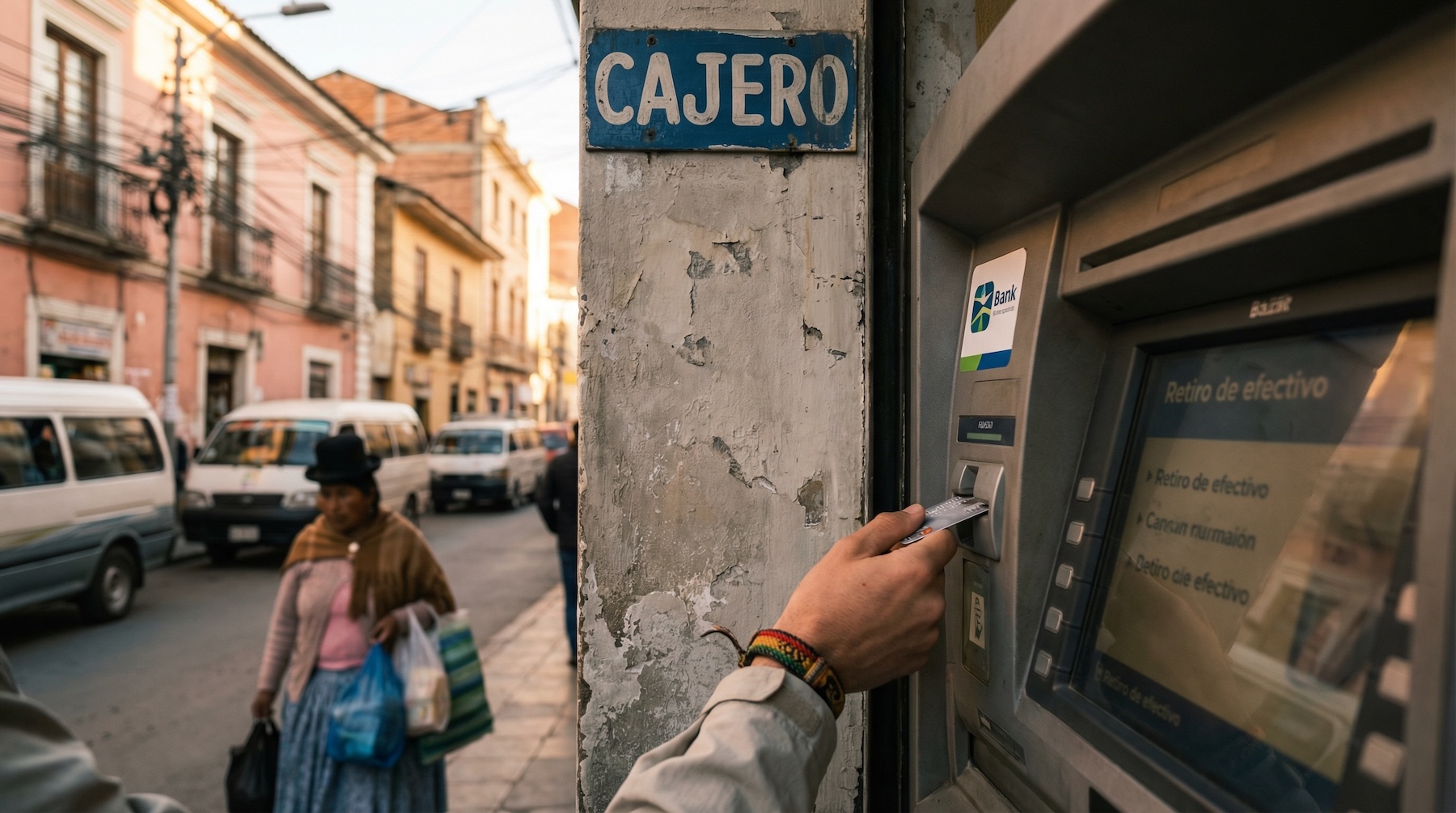
Here is something travelers to Bolivia figure out too late: the ATMs work fine. Most Bolivian banks do not even charge withdrawal fees for foreign cards. The problem is what happens before your cash comes out.
Every ATM in Bolivia converts your dollars at the official exchange rate of 6.96 bolivianos per dollar. Meanwhile, the parallel market rate sits around 9.05. That gap means you are getting roughly 30% less purchasing power on every withdrawal.
It is not a scam. It is not hidden fees. It is Bolivia’s dual exchange rate system, and it quietly costs unprepared tourists hundreds of dollars per trip. For the full context on why this gap exists, read our parallel dollar guide.
Wait, Bolivian ATMs Are Actually Fee-Free?
This surprises most people. Unlike ATMs in many countries, most major Bolivian banks do not charge foreign card fees at their ATMs.
Travelers on forums consistently report fee-free withdrawals from these banks:
- Banco Mercantil Santa Cruz (BMSC): the largest bank, widely available, confirmed fee-free
- Banco Nacional de Bolivia (BNB): another popular option with no ATM operator fee
- Banco Fie: confirmed by multiple travel bloggers
- BCP Bolivia and Banca Ganadero: also listed as fee-free options
Your own bank at home may still charge an international withdrawal fee (typically $2-5). But the Bolivian side is usually free.
One traveler on TripAdvisor summed it up: “Bolivian ATMs don’t actually charge a fee, just your bank and the exchange rate.”
That exchange rate is the real problem.
The Exchange Rate Is Where You Lose Money
Let’s do the math on a $200 withdrawal.
At the official rate (6.96): you get 1,392 BOB.
At the parallel rate (9.05): that same $200 would be worth 1,810 BOB.
Difference: 418 bolivianos. That covers about three nice dinners in La Paz or two days of hostel accommodation.
Over a two-week trip where you withdraw $500-800 total, you are looking at roughly $150-250 in lost purchasing power. Not from fees. Just from the exchange rate.
ATM Withdrawal Limits Add to the Annoyance
Most Bolivian ATMs cap withdrawals at 2,000 to 3,500 BOB per transaction (roughly $290-500 at the official rate). Some banks like BMSC allow higher amounts, up to BOB 4,500 or even $700 USD equivalent.
If you need more, you make multiple trips to the ATM. Not the end of the world, but not convenient either.
The Cash Alternative: Bringing US Dollars
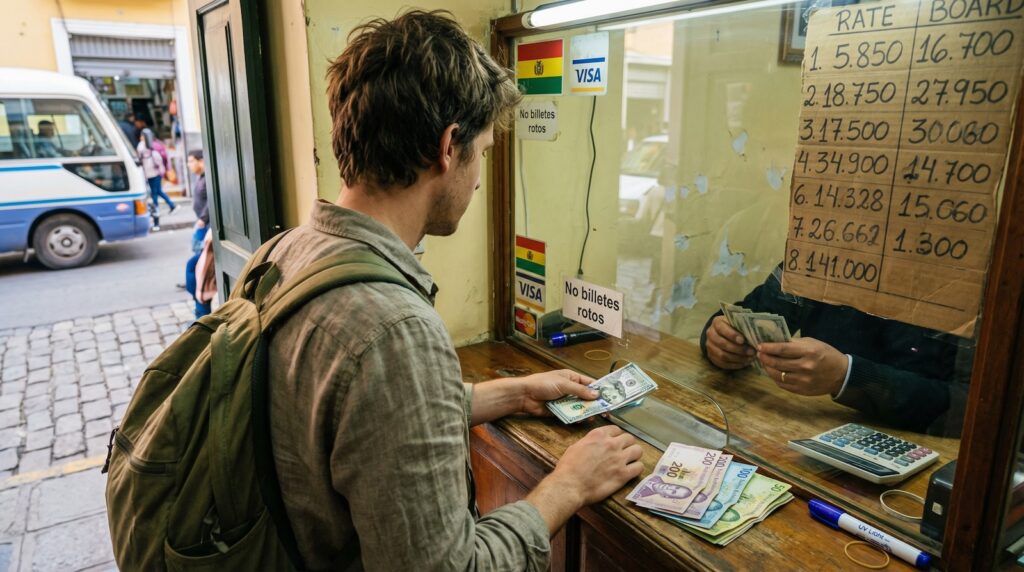
Most experienced Bolivia travelers bring US dollars and exchange them at casas de cambio (exchange houses) for the parallel rate.
This works well, but comes with its own set of considerations:
- Bill condition matters a lot. Bolivia is notoriously strict about USD bill quality. Torn, marked, or heavily creased bills get rejected. Exchange houses inspect notes under UV lights. Bring crisp, newer bills (2013 series or later).
- Denomination matters too. $50 and $100 bills get better rates. One Reddit user reported being offered “20% worse rates” for $20 bills compared to $100s.
- Safety is a consideration. Carrying large amounts of cash requires common sense. Exchange smaller amounts more frequently and be discreet.
- Stick to established exchange houses. Calle Camacho in La Paz is the main exchange street. Avoid street exchangers where counterfeit risk is higher.
A Third Option: QR Payments
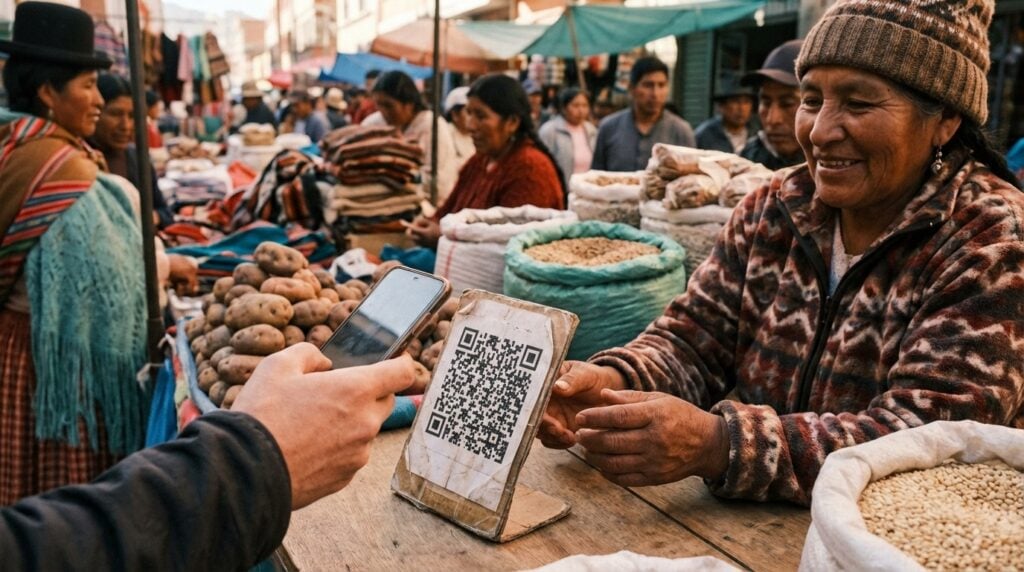
Bolivia has quietly built one of South America’s most advanced QR payment networks. Instant payments now make up 95% of all digital payments in the country.
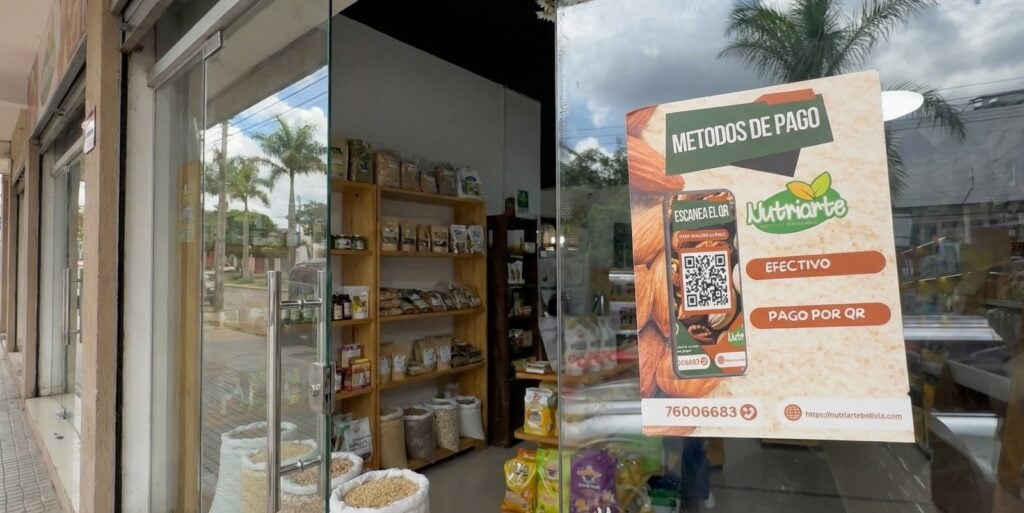
Walk into almost any store, restaurant, pharmacy, or taxi in La Paz, Santa Cruz, or Cochabamba and you will see a QR code. Street vendors, salteña stands, even tour guides accept QR. It is how Bolivians pay for everything.
Services like WanderWallet let you scan those same QR codes using your dollar balance. The conversion rate tracks the real market, not the official rate. WanderWallet’s current Bolivia rate is around 8.8 BOB per dollar, which is roughly 25% better than what you would get at an ATM. If you want to see how QR works on the ground, read Bolivia Runs on QR.
Here is how $200 breaks down across your options:
- ATM (official rate 6.96): 1,392 BOB
- WanderWallet QR (rate ~8.8): 1,760 BOB
- Cash at exchange house (parallel ~9.05): 1,810 BOB
Cash at the parallel rate gives you the most bolivianos. But QR payments give you most of the benefit without the hassle of carrying cash, finding exchange houses, or worrying about bill condition.
The Smart Approach
Bolivia’s ATMs are not a nightmare. They work, they are mostly fee-free, and they are everywhere. The issue is purely the exchange rate, which is set by the government and sits about 30% below what the market actually values the dollar at.
For most travelers, the best strategy combines all three options:
- Bring some USD cash ($100 and $50 bills, crisp and clean) for the best exchange rates at casas de cambio
- Use QR payments for everyday purchases: restaurants, stores, transportation in cities
- Keep ATMs as backup for when you need quick cash in remote areas or run low on dollars
The travelers who lose money in Bolivia are not the ones who use ATMs occasionally. They are the ones who use ATMs exclusively, not realizing there are better options available. If you are flying soon, set up WanderWallet Bolivia before your trip so your funnel is ready from day one.
Frequently Asked Questions
How can I pay in Bolivia as a foreigner?
Best practice is QR first, cash second, ATM backup. In real travel usage, QR works across most places foreigners spend, while cash helps for edge cases.
Can I pay with QR in Bolivia almost everywhere?
Yes. QR is a default payment method in Bolivia, including major cities, tourist hubs like Uyuni, and many small merchants. Carry a small cash buffer for rare edge cases.
Are Bolivia ATMs fee-free for foreign cards?
Often yes on the local ATM operator side, but your home bank may still charge fees. The larger cost is usually exchange rate: ATM/card flows often use official-rate FX.
Why do ATM withdrawals in Bolivia feel expensive even without fees?
Because they typically convert at Bolivia’s official rate (around 6.96) instead of parallel-market conditions (around 9.05), which can reduce purchasing power materially.
Is WanderWallet live in Bolivia and better than ATM rates?
Yes. WanderWallet is live in Bolivia and supports QR Simple. Recent traveler rates around 8.8-8.9 BOB/USD have been materially better than official-rate ATM/card conversion.
Should I use ATMs, cash exchange houses, or QR in Bolivia?
Use all three with clear priority: QR for daily payments, exchange-house cash for backup optimization, and ATMs only as fallback.
Ready to Start Paying with QRs in Bolivia?
Download WanderWallet and pay like a local.


About the Author

Milo
Milo writes about the stuff nobody tells you before you land: why your card gets declined, where cash still rules, and how to actually pay for things without getting ripped off. He's WanderWallet's resident payment nerd.