Bolivia’s Exchange Rate One Month Later: The Dollar Rose 25%
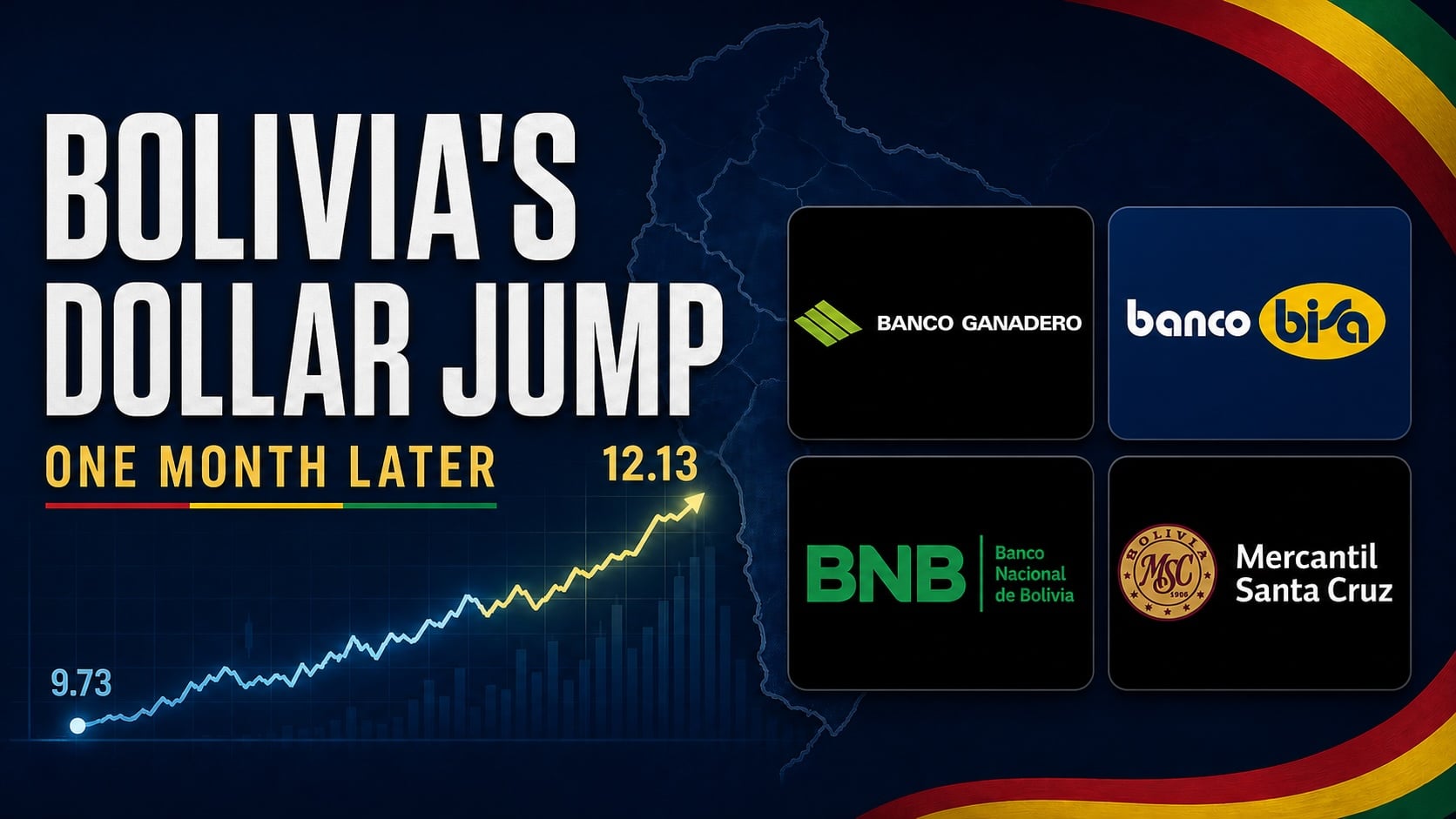
Bolivia’s formal dollar fixing rose from approximately 9.73 BOB/USD at the start of the new regime to 12.13 in the July 31 fixing, which became applicable on August 3, 2026. That is a 24.7% rise in the dollar’s BOB price, or a 19.8% loss in the boliviano’s value against the dollar. But the more important change for travelers is that Bolivia still does not have one exchange rate that every payment method follows.
TL;DR
The formal bank-dollar market moved sharply above 12 BOB, while the separate digital-dollar market that influences WanderWallet’s BOB conversion remained in the mid-11s during an August 1 check. A foreign card may be cheaper on one day and WanderWallet may be cheaper on another. A card rate is also not always final while a transaction is pending. Compare the amount after fees—and remember that WanderWallet lets a foreign visitor scan a merchant’s Bolivian payment QR and connect to the local payment rails.
Market snapshot: August 1, 2026. The latest BCB fixing was 12.13, published after the July 31 calculation and applicable from the next business day, August 3. The rate applicable on Friday, July 31 was 12.15. The BCB fixing, cash quotes, foreign-card conversions and WanderWallet’s BOB conversion can move quickly and may temporarily move in different directions.
What Happened to Bolivia’s Exchange Rate in One Month?
Bolivia began its flexible exchange-rate regime on June 29 with a 9.73 bolivianos-per-dollar reference calculated on June 26. The fixing moved gradually at first and then rose sharply during the final week of July. The July 31 calculation produced 12.13, which the BCB published that evening for the next business day.
| Fixing Date | BCB Weighted Average (BOB/USD) | Formal USD Volume | Applicable Date |
|---|---|---|---|
| June 26 | 9.7349 | $17.32 million | June 29 |
| July 27 | 11.5361 | $21.14 million | July 28 |
| July 28 | 11.7973 | $38.85 million | July 29 |
| July 29 | 11.8861 | $41.66 million | July 30 |
| July 30 | 12.1518 | $38.73 million | July 31 |
| July 31 | 12.1302 | $41.16 million | August 3 |
The daily figures are available in the Banco Central de Bolivia’s official 2026 exchange-rate history. The BCB homepage publishes the latest rate.
The timing matters. The BCB calculates the fixing from bank-customer transactions during a business day, publishes it that evening and applies the rounded rate on the next business day. A continuously moving cash or digital market can therefore disagree with the latest BCB fixing, especially around a weekend.
Did the Dollar Rise 25%, or Did the Boliviano Fall 20%?
Both statements are correct because they measure the same move from opposite directions.
- The dollar’s increase in BOB: 12.13 divided by 9.73, minus one, equals 24.7%.
- The boliviano’s loss against the dollar: one minus 9.73 divided by 12.13 equals 19.8%.
The denominators are different, so the percentages are not identical. The accurate summary is: the dollar rose approximately 25% in BOB terms while the boliviano depreciated approximately 20% against the dollar.
Why Did the Official Rate Jump So Quickly at the End of July?
The move was not created by one unusual quote. Under BCB Resolution 88/2026, the official rate is a weighted average of dollars that banks buy from their customers. The transactions behind the late-July rate show that the formal bank market itself repriced.
On July 31, the BCB’s detailed data recorded more than $41 million across 1,820 bank-customer purchases. Approximately 89% of that dollar volume traded at 12 BOB or more. That makes the move broad enough to treat as a real change in the formal market, rather than a thin outlier.
Why buyers and sellers accepted those prices is harder to prove from one week of transactions. Continuing dollar scarcity, demand from importers and savers, inflation expectations and uncertainty around the new regime can all contribute. A transaction-based formula reveals the market pressure; it does not remove the pressure or create more dollars.
Why Did the Digital-Dollar Market Not Rise at the Same Speed?
The BCB rate and a digital-dollar-to-BOB rate come from different groups of buyers and sellers. They are related, but they are not the same market and they do not have to move together every hour.
Imagine two exchange desks. One buys ordinary dollars from bank customers. The other matches people who want to exchange digital dollars for bolivianos. Even if both desks ultimately quote BOB per dollar, they can have different customers, different supply and different limits on moving money between them. One desk may quote 12.13 while the other remains around 11.50.
That is what the August 1 snapshot showed. The latest BCB fixing was 12.13, while public digital-dollar/BOB advertisements were concentrated around 11.50 to 11.60. The digital figures were advertised offers, not a completed-volume average like the BCB calculation. The comparison still shows that the two markets had temporarily separated.
There is no rule saying the digital market must catch up by rising. The formal rate could fall, the digital rate could rise, or the difference could persist. That is why a single exchange-rate number is no longer enough to decide how to pay.
Can a Card Look Cheaper and Still Post at a Different Rate?
Yes, in some cases—but not every card transaction is repriced at settlement.
A card payment is first authorized and then processed and posted. Visa says the majority of its cross-currency transactions keep the same network rate from authorization through settlement. Mastercard says its rate is generally tied to authorization, but a processing-time rate can be used when a rate cannot be applied at authorization. Your card issuer may also use its own conversion rules or add a foreign-transaction fee.
The practical lesson is to treat a public BCB rate, a card-network calculator and a pending card amount as three different things. A card can appear to offer the best rate when you tap, yet the final posted amount may differ because of processing rules or issuer fees. At the same time, Bolivia’s other rates may have moved again before the charge posts, changing which method looks cheapest for the next purchase.
If a terminal offers to charge you in your home currency instead of BOB, that is a separate merchant conversion known as dynamic currency conversion. The merchant’s rate and markup apply, not the normal card-network conversion. Read the displayed choice carefully.
Which Payment Method Is Cheapest in Bolivia Today?
There is no way to pay that can honestly be called the cheapest every day. Compare the cost you can actually access, including fees, and then check whether the merchant can process your foreign card or displays a QR for you to scan.
| How You Pay | What Determines the Cost | Main Uncertainty | Where It Works |
|---|---|---|---|
| Pay at a card terminal with a foreign card | Network or issuer conversion plus any issuer fee | A public rate or pending amount may not equal the final posted amount | Where the merchant can process international cards |
| Scan the merchant’s local QR with WanderWallet | WanderWallet’s in-app BOB quote and displayed fee | The quote for a future payment can move as the underlying market moves | Where the merchant acceps QR payments |
| Pay with exchanged cash | The exchange desk’s buy quote and spread | Rates vary by place, note condition and time | Cash transactions and backup |
| Withdraw cash from an ATM | Network or issuer conversion, ATM fee and issuer fee | Fees, limits and the final posted conversion | Obtaining cash when the total cost is acceptable |
In the August 1 snapshot, a low-fee foreign card whose own conversion was near 12 could be cheaper than WanderWallet’s BOB conversion based on the mid-11s digital market. On another day, those positions could reverse. And when a merchant asks you to scan their QR but cannot process your foreign card, the theoretical card rate does not help at checkout.
A Simple Way to Compare Before You Pay
- Start with the BCB rate as a benchmark, not a promise. It tells you what happened in the formal bank-customer market.
- Check the rate and fee shown in WanderWallet. The app shows the BOB payment amount and cost before you confirm.
- Know your card’s rules. Check the issuer’s foreign-transaction fee and compare a posted transaction, not only a network calculator or pending amount.
- Separate price from access. A card can be cheaper only where the merchant can process it. When the merchant expects payment through their QR, WanderWallet lets you scan that QR and connect to the local rails.
- Recheck before a large payment. A comparison from yesterday may already be stale in Bolivia’s current market.
Did Bolivia’s Exchange-Rate Reform Work?
It is too early for a simple yes or no. After one month, the reform appears to have done more to replace the artificial 6.96 benchmark than to create one stable price across every market.
| Objective | First-Month Result |
|---|---|
| Replace the old 6.96 benchmark | Achieved |
| Make the official rate reflect formal transactions | Achieved by the new method |
| Narrow the old official-versus-cash gap | Largely achieved in late-July snapshots |
| Create one price across bank, cash, card and digital markets | Not achieved |
| Stabilize the boliviano | Not yet |
| Restore abundant dollar liquidity | Not demonstrated yet |
On June 29, Economy.com.bo reported cash-market quotes around 9.80 to 9.90 while the new official reference was 9.73. On July 27, it reported an official rate of 11.37 and a parallel buy quote of 11.71. The enormous old gap had narrowed, but the new digital-market divergence shows that market unification remains incomplete.
What Is the BCB Doing About the Volatility?
On July 30, the BCB announced that it could buy or sell dollars directly, or use auctions, to reduce excessive short-term fluctuations, speculation or overshooting. It also said intervention would not defend one predetermined exchange rate.
The central bank said it had approximately $639 million available for possible intervention and expected at least $1 billion in additional foreign-currency flows between August and December. Those are the BCB’s own figures and projections, not a guarantee of future stability.
The announcement may influence expectations in cash and digital markets, but it does not prove why either market moved on a specific day. The second month will show whether intervention and new dollar inflows reduce the difference between them.
Does the Weaker Boliviano Make Bolivia Cheaper for Tourists?
It can give dollar-holding travelers more bolivianos, but that does not mean the whole country became 20% cheaper. At the opening reference and the July 31 fixing used here, a theoretical $100 calculation changed from about 973 BOB to 1,213 BOB. That is 240 additional bolivianos before spreads, product fees, card fees or ATM charges. It is arithmetic based on BCB references, not a guaranteed traveler quote.
Actual purchasing power depends on both the conversion method and local prices. Bolivia’s Instituto Nacional de Estadistica reported June inflation of 2.15% for the month and 9.23% over 12 months. Imported and dollar-sensitive goods may adjust differently from local meals, transport or services.
Where WanderWallet Fits When It Is Not the Cheapest Rate
WanderWallet is not guaranteed to beat every foreign card on every day. Its durable value in Bolivia is letting a foreign visitor pay via QR and connect to the local payment rails without opening a Bolivian bank account.
If the merchant can process your foreign card and the card’s final conversion is better after fees, using the card can make sense. If the merchant instead asks you to scan their QR, WanderWallet plugs that payment into the local rails. The app also shows its rate, fee and BOB payment amount before confirmation, so you can evaluate that quote at checkout.
Start with the WanderWallet Bolivia page for product setup. Read How Foreigners Can Pay in Bolivia for the practical options. For the policy change itself, see our June explainer, Bolivia’s Parallel Dollar Is Changing.
What Should We Watch During the Second Month?
- Whether the formal rate stabilizes or continues moving above 12 BOB/USD
- Whether the digital-dollar/BOB rate converges with the formal market, and in which direction
- Whether announced dollar inflows materially improve bank liquidity
- How foreign card transactions actually post after issuer fees
- Whether depreciation passes more visibly into consumer prices
The Bottom Line
One month after Bolivia replaced the old 6.96 exchange-rate reality, the formal dollar price had risen approximately 25% in BOB terms. But formal dollars, digital dollars, cash quotes and card conversions were no longer moving in lockstep.
For travelers, that changes the advice. Do not assume the BCB number is the rate your foreign card or WanderWallet conversion will use. Do not assume WanderWallet or a foreign card is always cheaper. Compare the available cost after fees, understand that a pending card charge may not be final, and check whether the merchant can process your card or expects you to scan their QR.
Frequently Asked Questions
What was Bolivia's latest formal dollar fixing at the start of August 2026?
The BCB’s July 31 fixing was 12.13 BOB per US dollar. It was published that evening and became applicable on the next business day, August 3. The rate applicable on Friday, July 31 was 12.15.
Why can WanderWallet's rate differ from the BCB reference?
The BCB reference is calculated from banks buying ordinary US dollars from their customers. WanderWallet’s conversion follows a separate market where digital dollars are exchanged for bolivianos. The two markets have different buyers, sellers and timing, so their rates can temporarily move in different directions.
Is WanderWallet always cheaper than a foreign card in Bolivia?
No. A foreign card may be cheaper when the merchant can process it, the final posted conversion is favorable and the issuer adds little or no foreign-transaction fee. WanderWallet serves a different need too: it lets a foreign visitor scan the merchant’s Bolivian payment QR and connects that payment to the local rails. The app shows its rate, fee and BOB amount before confirmation.
Can a card's exchange rate change after I pay?
Sometimes. Many Visa and Mastercard transactions apply the network rate when the purchase is authorized, but a later processing-time rate can apply in some cases and the issuing bank may use its own rules or add fees. Treat a pending amount as provisional until the transaction posts; a later BCB move does not automatically reprice every card purchase.
Do foreign cards automatically use Bolivia's official exchange rate?
No. The BCB rate is a reference calculated from formal bank-customer dollar purchases. A foreign card’s final cost depends on its network, issuing bank, conversion timing and fees, so it may be above or below the BCB reference.
How should travelers compare a foreign card, WanderWallet, cash and ATM costs in Bolivia?
Compare the cost of paying the same BOB amount after all rates and fees, then check how the merchant expects to be paid. Use the final posted home-currency amount for a card, WanderWallet’s pre-confirmation quote when scanning the merchant’s QR code, the counter quote for cash and the full network, ATM and issuer cost for a withdrawal.