

How Foreigners Can Pay with Pix and Manage Money in Brazil (2026 Guide)
💡 TL;DR:
- Brazilians make most transactions with an instant, free, and digital payment system called Pix. Cash is rarely used.
- Pix normally requires a local tax ID (CPF) and bank account to use, but WanderWallet gives foreigners access without either.
- Foreign credit cards are not always accepted, relatively expensive to use, and might incur in foreign transaction fees by your bank.
- For both locals and foreigners, Pix is the overall easiest, cheapest, safest, and most widely accepted way to pay for almost anything.
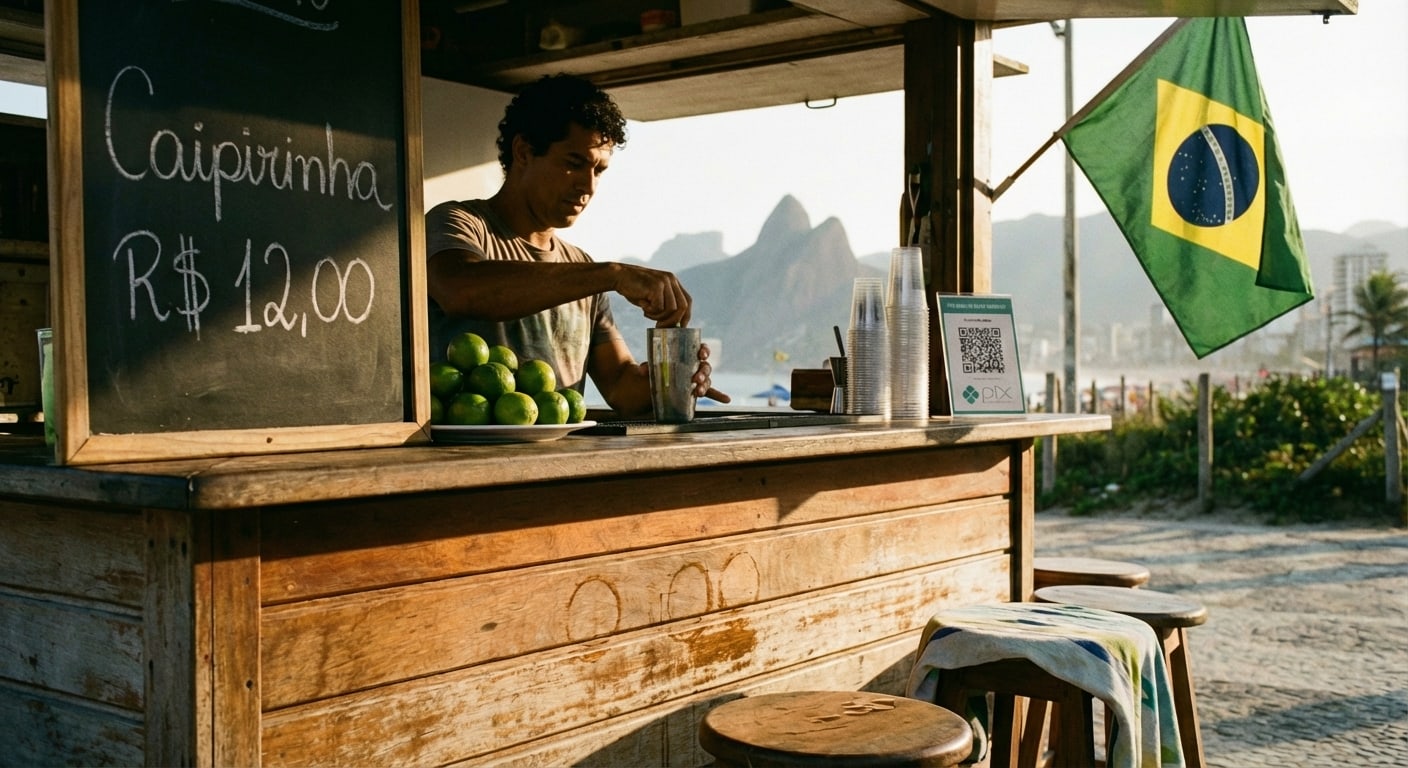
Brazil is one of the most cashless countries in Latin America. Most daily transactions now flow through Pix, an instant and free payment system created by Brazil’s central bank.
Pix has become essential for Brazilians, but most foreigners are locked out without both a local tax ID (CPF) and bank account. That leaves two less-ideal alternatives: cash, which is increasingly uncommon and carries safety concerns, or foreign credit cards, which (if accepted) might bear a transaction fee disguised as IOF (Brazilian’s tax for foreign operations).
This guide shows how foreigners can access Pix legally and instantly through WanderWallet, and explains Pix’s many advantages over alternatives for all types of payments. It will also help you decide to what extent you may want to keep some cash on hand, and where your best options are for small withdrawals.
Table of Contents
- What You Can Do With Pix
- How Pix Compares to Alternatives
- Cash – How Much to Carry and How to Withdraw
- Future Outlook
- References and Resources
- FAQ
What You Can Do With Pix
Pix is a complete payment system that covers virtually every type of transaction in Brazil. With WanderWallet, foreigners can use all of these functions instantly without a CPF or local bank account.
Pix Capabilities at a Glance
| Pix Capability | What It’s Used For | Key Advantages |
|---|---|---|
| QR Code Payments | Restaurants, supermarkets, taxis, street vendors | Fast, universal acceptance for in-person payments |
| Direct Transfers (Pix Keys) | Rent, splitting bills, paying friends or service providers | Instant and secure. No requirement for the recipient’s banking details |
| Online Checkout | E-commerce, delivery apps, digital services | Wider acceptance, often discounts |
| High-Value or Recurring Payments | Rent, lessons, cleaners, therapists | Preferred by landlords and service providers; replaces Wise transfers |
| Cash Access (Pix Saque) | Withdrawing small amounts of cash | Faster and better rates than traditional ATM withdrawals |
💡 TL;DR:
These capabilities cover nearly all payment scenarios a traveler or nomad will encounter in Brazil—large payments, daily purchases, online checkouts, and even cash access. For most foreigners using WanderWallet, Pix can serve as the primary payment method, with cards and cash used only in specific situations.
How Pix Compares to Alternatives
Pix (via WanderWallet) is usually the most reliable and economical way for foreigners to pay in Brazil. Here’s how it compares directly to the main alternatives available to visitors.
Payment Method Comparison – Every Day Purchases
| Method | Acceptance | Rates & Fees | Transparency | Verdict |
|---|---|---|---|---|
| Pix (via WanderWallet) | Accepted everywhere in Brazil | Near mid-market exchange rate; no IOF tax; minimal fixed fee | Full BRL/USD amount and rate shown before payment | Best overall option for foreigners in Brazil |
| Credit / Debit Cards | Good at large purchases, inconsistent at small merchants | Uses official rate, possible DCC markups | Often unclear until statement posts | Convenient backup, but expensive and less reliable |
| Cash | Universally accepted but rarely preferred | ATM fees + FX spread; carrying risk | Varies by ATM or exchange office; often not displayed | Good only as a small emergency reserve |
💡 TL;DR:
Pix covers nearly all daily spending and offers the best combination of acceptance, cost, and predictability. Cards remain a workable backup in larger businesses, while cash is now limited to occasional or rural situations.
Payment Method Comparison — Rent and Personal Transfers
| Method | Use Cases | Rates & Fees | Challenges | Verdict |
|---|---|---|---|---|
| Pix (via WanderWallet) | Paying rent, splitting bills, sending BRL to anyone in Brazil | Mid-market rate; no IOF; instant settlement | No bank details required; just send to a Pix key | Fastest and cheapest option |
| Wise | Larger transfers to Brazilian bank accounts | Mid-market rate; +2% total fees | Requires full bank details (agency, account number, CPF); slower | Good for occasional large transfers |
| PayPal | Rarely used in Brazil | High fees and weaker FX rates | Low acceptance; not widely integrated | Generally poor value |
💡 TL;DR:
In Brazil, rent and peer-to-peer payments almost always happen through Pix. Locals prefer to send their Pix key rather than full banking details; they just send a Pix key.
WanderWallet makes it simple: enter the recipient’s Pix key (often a phone number or email), confirm the amount, and funds arrive instantly in BRL. It’s fast, private, and consistently cheaper than alternatives.
Safety and Privacy
Pix is operated and regulated by the Central Bank of Brazil, using the same security standards as online banking. Transfers are encrypted, traceable, and confirmed instantly.
For foreigners, Pix is generally safer than carrying cash and more reliable than using a foreign card at unfamiliar terminals. Privacy rules also prevent transaction data from being shared with other government agencies without due process.
Cash: How Much to Carry and How to Withdraw
Brazil is now one of the most cashless countries in Latin America. Most locals go days or weeks without touching physical money, and nearly every everyday purchase—from taxis to street food to rent—is easier with Pix. As a foreigner using WanderWallet, you can rely on Pix entirely.
That said, it’s still wise to keep a small emergency reserve of cash on hand. Usually R$50 – R$150 is enough. This covers situations where you temporarily lose signal, your phone battery dies, or you’re passing through a very small town where digital payments may be spotty.
Cash Withdrawals with Pix-Saque (Recommended for Foreigners)
WanderWallet supports Pix-Saque, Brazil’s cash-withdrawal system that lets you take out BRL using Pix instead of a foreign card. It’s typically cheaper, safer, and more transparent than withdrawing with an international debit card.
You can use Pix-Saque at:
- Casas Lotéricas (lottery shops in most neighborhoods)
- Participating retailers such as supermarkets and convenience stores
Advantage over foreign cards:
- Near mid-market exchange rates
- No risk of 4.38% IOF tax
- Minimal fixed fee
- Full transparency before you commit
- No risk of ATM-skimming as opposed to traditional card withdrawals
How to withdraw cash with Pix-Saque using WanderWallet:
- Find a Pix-Saque location (ATM, lottery shop, or participating store).
- Select the Pix Saque option and enter the amount in BRL.
- A Pix QR code will appear.
- Open WanderWallet → Pay Now → scan the code.
- You’ll see the exact USD cost, fee, and exchange rate before confirming.
- Confirm the payment and collect your cash instantly.
Using a Foreign Debit or Credit Card at ATMs
You can withdraw cash with a foreign card at Banco do Brasil, Bradesco, Santander, Itaú, and Banco24Horas ATMs, but it’s generally a poor-value option: you could get hit with the 4.38% IOF tax, a foreign ATM fee, weaker exchange rates, and risk occasional declines. For most travelers, foreign cards are best kept as a last-resort withdrawal method.
💡 TL;DR:
You’ll need very little cash in Brazil—but when you do, Pix-Saque through WanderWallet is the most cost-effective and reliable way to withdraw it. Keep only a small reserve for emergencies, and use Pix for everything else.
Future Outlook
Brazil continues to expand Pix as its core payment infrastructure. New features, including cross-border trials, digital ID integration, and broader support for online services, are expected to make Pix even more central to daily life.
However, the CPF and local bank account requirements remain barriers for most visitors. Until those barriers are removed, services like WanderWallet will remain the simplest way for foreigners to use Pix legally and instantly. As Brazil becomes increasingly cashless, Pix via WanderWallet is likely to grow from the recommended option to the default option for most travelers and nomads.
References and Resources
- Central Bank of Brazil – Official Pix Portal
- WanderWallet Guides – Pix for Foreigners | Pix vs Credit Card
- The World – Brazil’s Pix Payment System Reshapes How Millions Pay (Oct 2025)
- Wise Currency Converter – BRL/USD Mid-Market Rate
- Gringo.Rio – Expat Forum & Payment Tips
Frequently Asked Questions
Can foreigners use Pix without a CPF?
Not through Brazilian banks, but yes through WanderWallet, which lets foreigners make Pix payments without a CPF or local account.
Are credit cards still useful in Brazil?
Yes, but mainly at larger businesses. Cards may be declined at smaller merchants, and rarely offer the best exchange rate (some banks will charge you the IOF equivalent as a fee).
Do I need cash in Brazil?
Only as a backup. Brazil is highly cashless, and Pix is preferred for nearly all transactions. Keep a small reserve for rural areas or emergencies.
What is the IOF tax?
A federal tax of 4.38% that applies to all exchange operations made in traditional banking in Brazil.
Ready to Start Paying with Pix?
Download WanderWallet and pay like a local in Brazil.


About the Author

Dan Volgenau
Dan is a contributing writer for WanderWallet. He has lived in Latin America for five years, primarily in Buenos Aires, Argentina. He has a degree in Economics from Dartmouth College.