

What Is Bre-B? Colombia Payments Explained for Travelers
Bre-B is Colombia’s instant payment system for moving money between people, businesses, banks, and digital wallets. For travelers, the important part is not the banking infrastructure. It is that Colombia now has one shared rail underneath Nequi, Daviplata, the bank apps, and the QR codes on card terminals and counters, and that visitors can pay through it.
TL;DR
- Bre-B is the interoperable instant-payment layer run by Colombia’s central bank, live since October 2025. Participating banks and wallets, including Nequi, Daviplata and Bancolombia, connect to it.
- People pay each other against a payment key (a “llave”), usually a phone number or a business ID, or by scanning a Bre-B QR.
- Since 2026, card terminals can show a Bre-B QR at checkout, and banks are replacing their older printed QR labels with Bre-B ones.
- A merchant may still say “Nequi” and hand you a phone number. That number is usually also their Bre-B key.
- Bre-B itself does not add a separate fee for the sender or merchant in the flow described here. WanderWallet’s conversion and payment fees still apply and are shown before you confirm. Paying it normally needs a Colombian account; WanderWallet gives visitors that access.
What Is Bre-B in Colombia?
Bre-B is the brand for Colombia’s interoperable instant-payment system, led by Banco de la Republica, Colombia’s central bank. It went live for the public on 6 October 2025. Its purpose is to make digital payments work across different banks, wallets, and financial institutions instead of leaving users stuck inside one provider’s network.
Adoption has been fast. In its six-month update (April 2026), the central bank reported more than 670 million transactions, over 34 million users and more than 103 million registered keys. These figures are from April 2026, not a current count.
The closest mental model is Brazil’s Pix: a national instant-payment rail that lets people pay or receive money using simple identifiers. But Bre-B is Colombia’s system, with Colombian terminology, Colombian institutions, and its own rollout path. It should not be treated as a copy of Pix.
The Two Words to Know: Key and QR
The most useful local word is llave, which means key. A payment key is an identifier that points to the person or business receiving the money. Depending on the institution it may be a phone number, a document or business ID number, an email, or another registered identifier. In everyday life it is usually a phone number, and for a business its ID number.
The second is QR. Bre-B QR codes contain payment details so you can scan instead of typing recipient information. A static printed QR requires you to enter the amount. Since 2026 they show up in two places: on the screen of card terminals at checkout, and on printed labels next to the register.
Why Colombia Payments Used to Feel Fragmented
Colombia already had strong local digital-payment habits before Bre-B, but they were not simple for visitors. A Colombian resident might use Nequi, Daviplata, Bancolombia, another bank app, a QR code, a phone number, a bank transfer, or cash depending on the merchant and situation, and those systems did not always talk to each other.
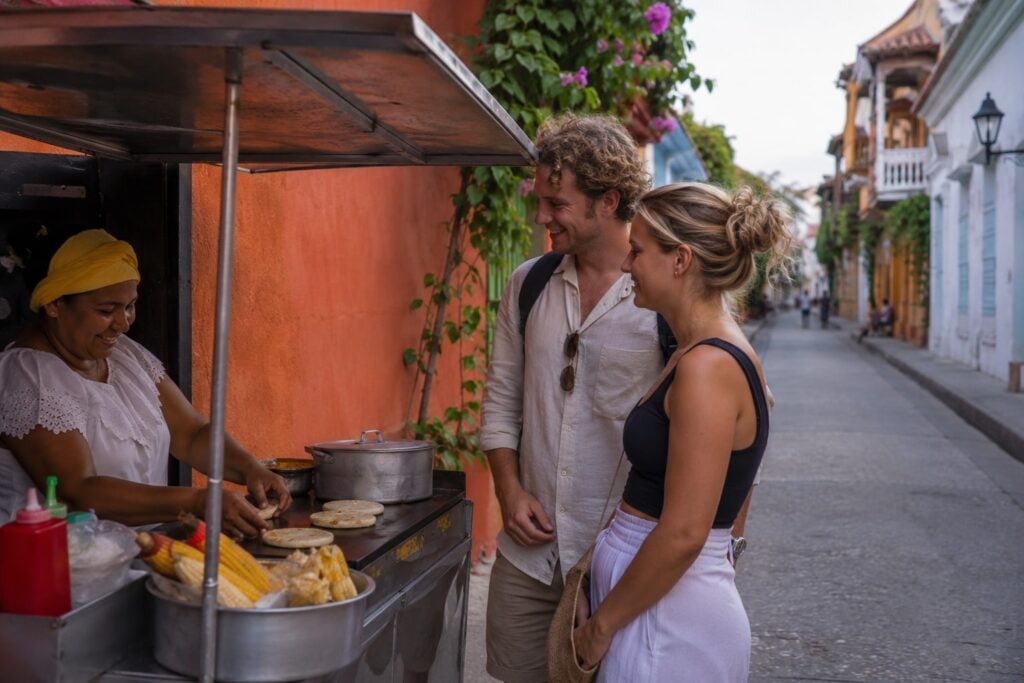
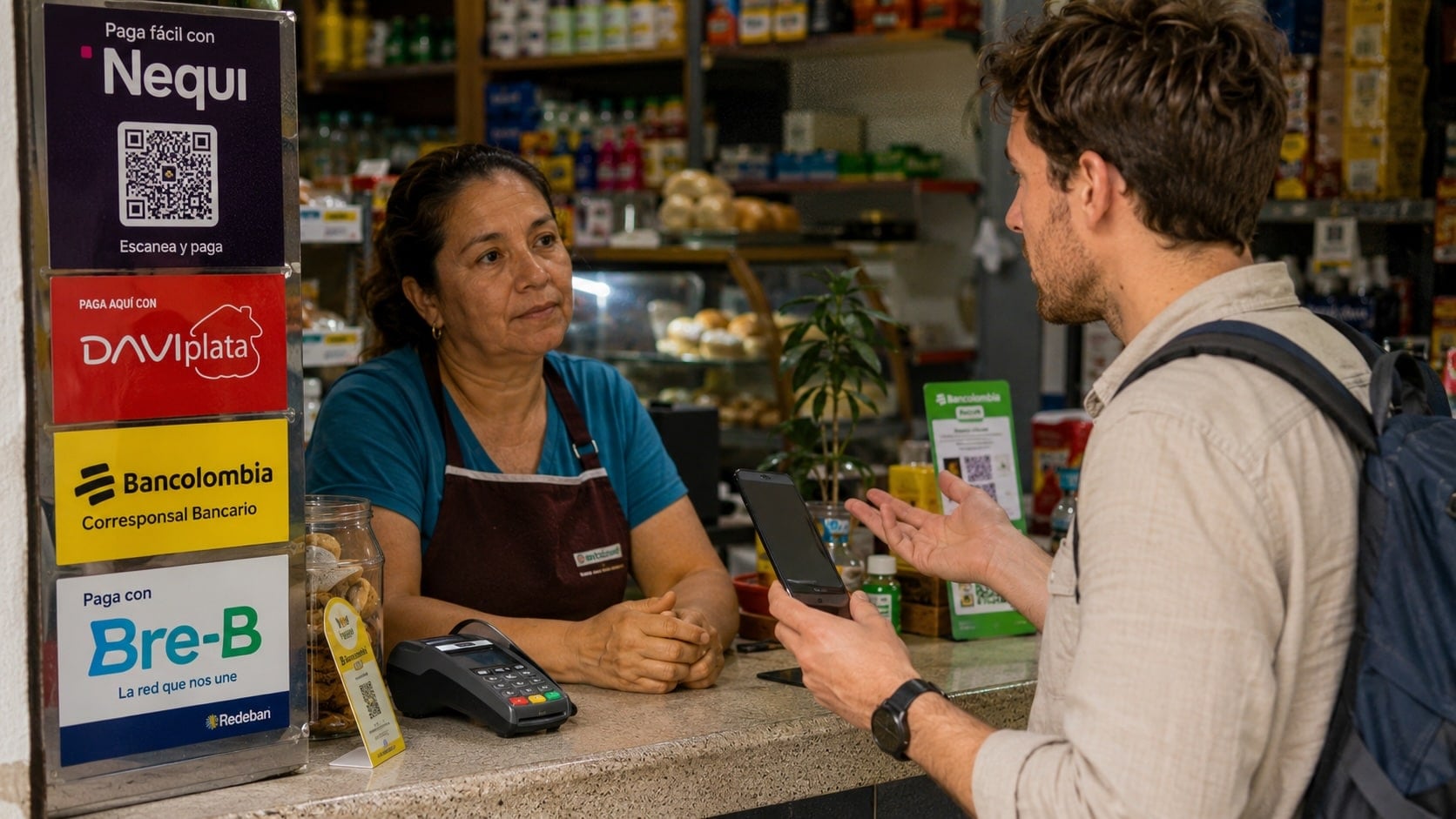
For locals this worked because they had Colombian documents, local accounts, and the right app installed. For a traveler it created checkout friction: a Nequi sign at a tienda, a Daviplata number at a food stand, a Bancolombia account at a tour desk, a QR code at a cafe. They looked like different worlds.
Bre-B sits above that. The merchant may still say the name of the app they know, but the payment now routes through a shared system underneath.
Bre-B vs Nequi, Daviplata, and Bancolombia
Bre-B is not another wallet app. It is the payment system that participating banks and wallets connect to.
| Term | What It Means | Why Travelers Hear It |
|---|---|---|
| Bre-B | Colombia’s interoperable instant-payment system | The shared rail behind transfers, keys, and the new QRs |
| Llave | A payment key linked to a recipient | A merchant gives a phone number or business ID instead of bank details |
| Nequi | A popular Colombian digital wallet | Many small merchants and individuals use it as their everyday payment app |
| Daviplata | A widely used Colombian wallet connected to Davivienda | Another common wallet travelers are asked to pay |
| Bancolombia | One of Colombia’s largest banks | Its printed QR labels are the most common ones on counters |
The practical point: when a seller says “solo Nequi,” they usually mean “this is how I receive digital payments.” If their phone number is registered as a Bre-B key through Nequi, that number works through Bre-B too. Not every number or merchant setup is guaranteed to be connected, which is why the recipient-name check in the app matters.
QR in Colombia: What Changed in 2026
For its first months Bre-B was mostly about transfers between people. The central bank’s April 2026 update confirms merchant QR interoperability, and the two big card-terminal networks, Redeban and Credibanco, plus newer terminal providers, connected their terminals during 2026. The result is the thing most visitors do not know: major terminal providers support Bre-B QR payments across Colombia, with participating terminals showing one on screen instead of taking a card. You ask to pay by QR, the terminal displays it, you scan it.
The printed labels are catching up too. Colombia’s counters are covered in QR stickers, most of them Bancolombia’s, and there are two generations. Older ones may use a legacy format that WanderWallet does not support. The newer ones say Bre-B on the label. Banks are replacing the old ones merchant by merchant, so for now the rule is simply to look for the word Bre-B.
The Key Traveler Insight: Ask for the Key, or the QR
If a merchant says Nequi, Daviplata, or Bancolombia, you have two good moves. Ask whether they can show a Bre-B QR (“me da el QR de Bre-B?”), or ask for their key, which in everyday situations is the phone number they were going to give you anyway (“me da su llave de Bre-B, o el numero de Nequi?”).
This keeps the conversation practical. You do not need to explain payment infrastructure while people are waiting behind you. And before confirming any payment, check the recipient name the app shows you. If it looks wrong, stop and ask again.
Why Bre-B Matters for Foreigners
Many Colombian payment apps are built for residents: local documents, a Colombian phone setup, a local bank relationship. That is normal for a domestic financial system and frustrating if you are visiting Medellin, Bogota, Cartagena, or the coffee region for a few weeks. Foreign cards work in many formal businesses, but smaller restaurants, neighborhood shops, tour providers, and street-level merchants often prefer local digital payments or cash, and the card terminals that do take foreign cards tend to offer to charge you in dollars at a markup.
Bre-B moves the question from “which closed app do you have?” to “what key or QR should this payment go to?” That is a better model for travelers. The remaining gap was access: paying Bre-B needs a Colombian bank or wallet account.
How WanderWallet Fits In
WanderWallet’s role in Colombia is to close that gap: pay through Bre-B, by QR or by direct transfer, from a digital-dollar balance, which you can fund in dollars or euros, without a Colombian bank account, with the recipient name, the amount in pesos and the final cost shown before you confirm. In Brazil the same idea runs on Pix; in Argentina and Bolivia on local QR and transfer rails.
The exact in-app steps for both flows are in How to Pay in Colombia With WanderWallet.
Related Guides
- How Dynamic Currency Conversion Works in Colombia – the dollars-or-pesos prompt explained.
- How I Pay in Colombia: Bre-B Transfers and QR – Vojta’s day-to-day experience in Medellin.
- How to Pay in Colombia With WanderWallet – the step-by-step for QR and direct transfers.
- Money and Pix for Foreigners in Brazil – a useful comparison if you already understand Pix.
- QR Payments for Tourists in Argentina – how another local-payment market works for visitors.
- How to Pay in Bolivia as a Tourist – another example of paying through local rails without a local account.
Bottom Line
Bre-B gives Colombia one shared instant-payment layer above a landscape that used to be confusing from the outside. Travelers will still hear Nequi, Daviplata, Bancolombia, phone number, transfer, and QR. The shift is that those all connect to the same system underneath, that system now reaches the card terminal at the supermarket, and visitors can pay through it.
If you remember one thing: ask for the Bre-B QR or the key. Then read the name before you confirm.
Adoption figures from Banco de la Republica, April 2026. Terminal and label observations as of September 2026.
Frequently Asked Questions
What is Bre-B in Colombia?
Bre-B is Colombia’s interoperable instant-payment system. It lets participating banks and wallets move money using payment keys, known as llaves, instead of requiring every payment to stay inside one app.
Is Bre-B the same as Nequi?
No. Nequi is a popular Colombian wallet. Bre-B is a broader payment system that wallets and banks can connect to. A Nequi phone number may also work as a Bre-B payment key if it has been registered that way.
What is a llave in Colombia payments?
A llave is a payment key linked to the person or business receiving money. It may be a phone number, document number, email, merchant identifier, or another supported identifier depending on the institution.
Can tourists use Bre-B in Colombia?
Tourists generally cannot access every local Colombian banking app the same way residents can. The practical opportunity is using services that connect travelers to local payment rails, then paying to a Bre-B llave when the recipient is supported.
Ready to Start Paying with Bre-B in Colombia?
Download WanderWallet and pay like a local.


About the Author

Milo
Milo writes about the stuff nobody tells you before you land: why your card gets declined, where cash still rules, and how to actually pay for things without getting ripped off. He's WanderWallet's resident payment nerd.